System Analysis and Design

Big data: The next frontier for innovation, competition, and productivity
BY
VENKATESH NARALASETTY
50120068
BEFORE….
-
Reforming the US health care system to reduce the rate at which costs have been increasing while sustaining its current strengths is critical to the United States both as a society and as an economy.
-
Health care, one of the largest sectors of the US economy, accounts for slightly more than 17 percent of GDP and employs an estimated 11 percent of the country’s workers.
An aging US population and the emergence of new, more expensive treatments will amplify this trend. The magnitude of the problem and potentially
Long timelines for implementing change make it Imperative that decisive measures aimed at increasing Productivity begin in the near term to ease escalating cost pressures.
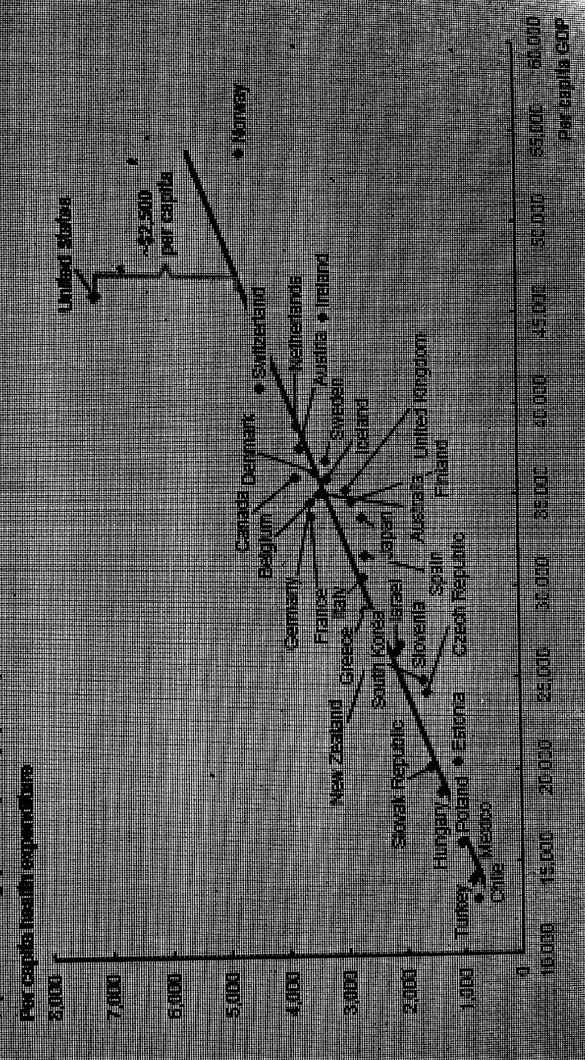
A comparison with OECD countries suggests that the total economic potential for efficiency
Improvements is about $750 billion.
Health care systems in the United States and beyond have shown early success in their use of big data The fiscal pressures imposed by rising health care costs have motivated the creation of a promising range of pilot programs in the United States and beyond that use big data and its analytical and management levers to capture real medium- and long-term value. Examples of such innovations include:
The Department of Veterans Affairs (VA) in the United States has successfully demonstrated several health care information technology (HIT) and remote patient monitoring programs. The VA health system generally outperforms the private sector in following recommended processes for patient care, adhering to clinical guidelines, and achieving greater rates of evidence-based drug therapy. These achievements are largely possible because of the VA’s performance-based accountability framework and disease-management practices enabled by electronic medical records (EMR) and HIT.
PRESENT…
-
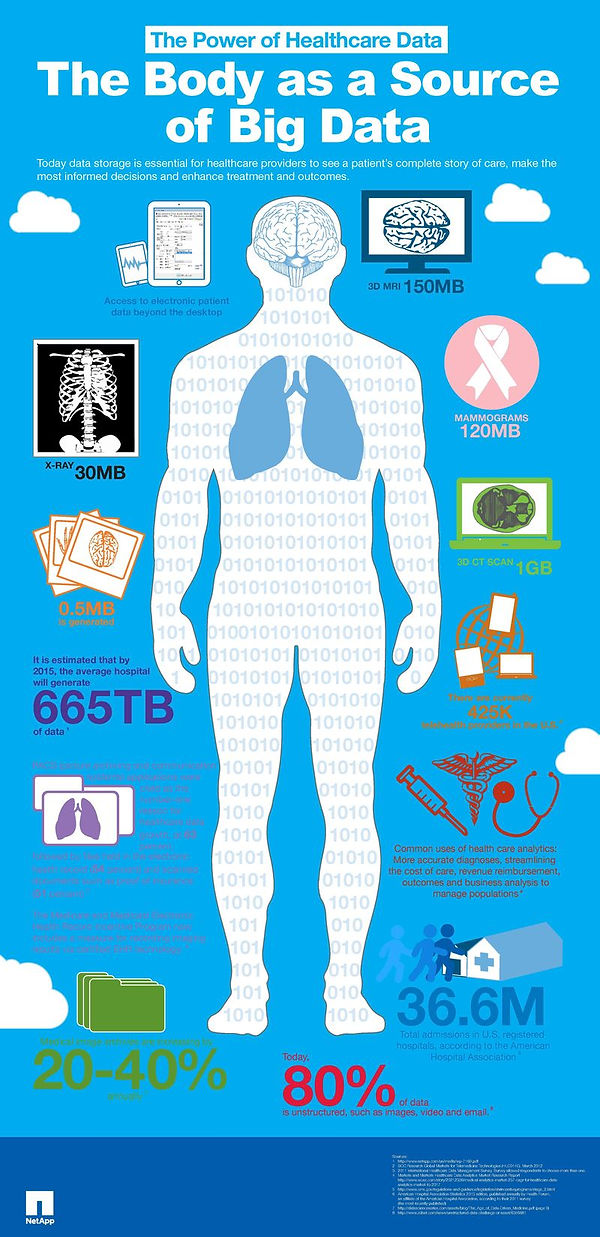
There’s a quiet revolution a foot: health data are increasingly collected, stored and used in digital form. Doctors, nurses, researchers, and patients are all producing on a daily basis huge amounts of data, from an array of sources such as electronic health records, genomic sequencing, high-resolution medical imaging, ubiquitous sensing devices, and smart phone applications that monitor patient health.
The remarkable expansion of digital health data is largely driven by technological developments, not least the expansion of broadband access, smart mobile devices and smart ICT applications. Improvements in data analytics have also played a significant role, as has the provision of super-computing resources through cloud computing. It supports informed decision making by providing operators with real-time data, which is critical for the ever-changing industrial water treatment system.
Big data also requires large numbers of people who are very highly trained and in huge demand from other sectors. Data specialist skills could become the most critical enabler for big data dementia research. Incentives are needed to promote education and training of data analysts and bioinformatics experts to use big data effectively for health research.
-
Of course, the explosion of promising new technological opportunities and data generation will not automatically translate into new products and care solutions for dementia and other neurodegenerative diseases.
-
Researchers in industry, hospitals and universities continue to make significant contributions to scientific understanding. But without better data sharing, interpretative capacity, and co-ordination of knowledge, we can make only limited progress in our understanding of the molecular basis of neurodegenerative diseases or whether treatments or interventions work.
FUTURE….
-
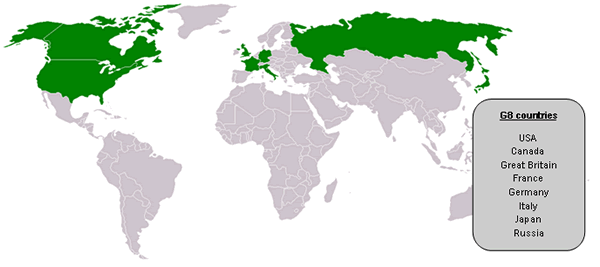
G8 countries made a bold and ambitious commitment to find a cure for dementia by 2025.
-
This commitment has been a catalyst for global action to improve the health and social care of people with dementia and to accelerate innovations to discover new therapies to prevent or limit this disease.
-
New opportunities are already in sight.
-
Current progress is encouraging but there is no room for complacency.
-
Current progress in development of electronic health care data enables a quantum leap forward in our understanding of dementia patients and their care.
-
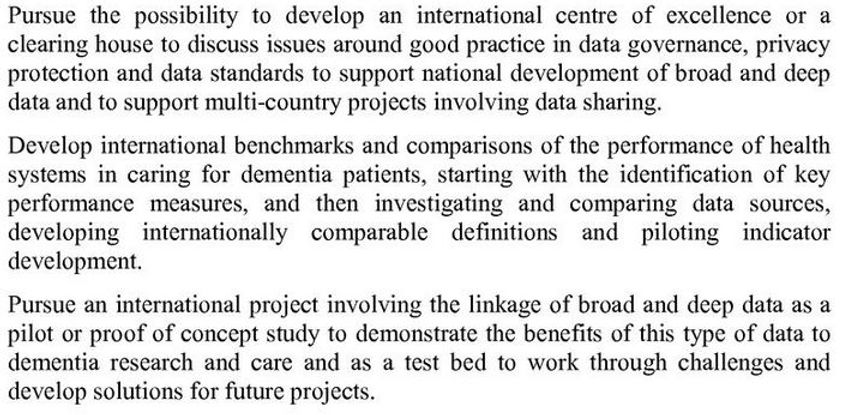
Opportunities should be pursued further, for example, through efforts to develop a center of global excellence tackle outstanding technical, legal and data challenges and to support countries in enabling the use of data needed to find a cure and improve care.
CONCLUSION