top of page
System Analysis and Design

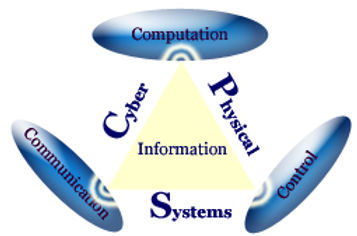
A cyber-physical system (CPS) is a system of collaborating computational elements controlling physical entities. Today, a precursor generation of cyber-physical systems can be found in areas as diverse as aerospace, automotive, chemical processes, civil infrastructure, energy, healthcare, manufacturing, transportation, entertainment, and consumer appliances. This generation is often referred to as embedded systems. In embedded systems the emphasis tends to be more on the computational elements, and less on an intense link between the computational and physical elements.
Unlike more traditional embedded systems, a full-fledged CPS is typically designed as a network of interacting elements with physical input and output instead of as standalone devices.[1] The notion is closely tied to concepts of robotics and sensor networks with intelligence mechanisms proper of computational intelligence leading the pathway. Ongoing advances in science and engineering will improve the link between computational and physical elements by means of intelligent mechansims, dramatically increasing the adaptability, autonomy, efficiency, functionality, reliability, safety, and usability of cyber-physical systems.This will broaden the potential of cyber-physical systems in several dimensions, including: intervention (e.g., collision avoidance); precision (e.g., robotic surgery and nano-level manufacturing); operation in dangerous or inaccessible environments (e.g., search and rescue, firefighting, and deep-sea exploration); coordination (e.g., air traffic control, war fighting); efficiency (e.g., zero-net energy buildings); and augmentation of human capabilities (e.g., healthcare monitoring and delivery).
Please find the Downloads for article on Cyber Physical Systems
bottom of page